Pairing real-time vehicle dynamics with a virtual IMU for more resilient hands-free control
2026-08-05
Authors: Ashraf Abualfellat, Senior Systems Engineer, GM Path/Route Following Capability Team; Hassan Askari, AV Vehicle Motion Estimation Software, GM ADAS Core organization; Matt Kempeinen, Staff Systems Engineer, GM Automated Driving Production Technology.
- Advertisement -
Keeping hands-free control aligned with real vehicles in the real world
Real-time vehicle dynamics modeling is central to how GM makes hands-free driving more capable and resilient. As Super Cruise has matured, the engineering teams have seen the same pattern across countless development miles: real vehicles don’t behave like fixed calibration tables. They evolve with tires, load, road friction, temperature, and perhaps most strikingly, whether a trailer is attached.
One of the clearest ways these effects appear in our lateral dynamics model is through how the vehicle’s understeer coefficient is represented. The understeer coefficient describes how steering response evolves as lateral acceleration builds, and whether the vehicle tends to push wide (understeer) or rotate more readily (oversteer) as cornering forces increase. While sometimes treated as a fixed value, on the road it is anything but fixed. Tire wear, tire pressure, temperature, vehicle loading, and hitch loads all reshape the true coefficient over time, and any mismatch between the assumed value in the model and the actual value in the car shows directly as path-tracking error.
We saw this directly in lateral path-tracking tests. Holding speed, road geometry, and conditions closely matched from run to run. We put the same vehicle through a highway curve and saw slightly different tracking performance each time. One pass showed a small positive offset wide of lane center, another held lane center cleanly, and a third showed a small negative offset toward the inside. The deviations were small but repeatable, which ruled out noise, transient sensor error, and driver style and pointed instead to the lateral controller and its internal vehicle model.
At the same time, the team was tackling a complementary challenge: what happens when the inertial measurement unit (IMU) — a sensor module that measures accelerations and angular rates (and sometimes orientation) to give the system a real-time view of the vehicle’s motion — is momentarily unavailable? Within that IMU signal, yaw rate — how quickly the vehicle rotates about its vertical axis — is one of the most important inputs for lateral control because it closes the loop between the intended path and the vehicle’s actual motion. When that signal disappears, even briefly, control performance can degrade if the system has no credible substitute.
- Advertisement -
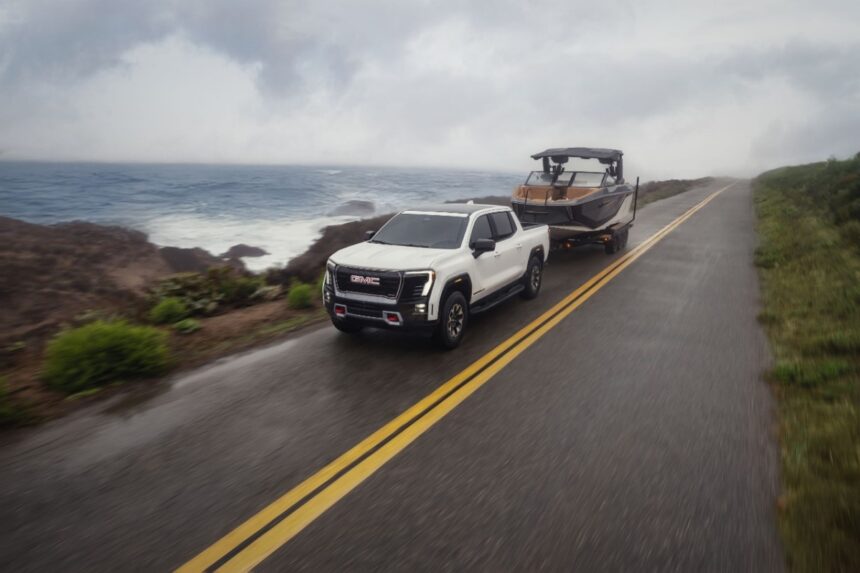
These two challenges — a vehicle model that needs to stay aligned with a changing car in a changing world, and a sensing path that must be robust to rare IMU dropouts — come together most strongly in demanding use cases like trailering. A trailer adds mass, shifts the center of gravity, increases yaw inertia, and introduces articulation forces at the hitch, all of which reshape the vehicle’s response in a turn and vary with trailer size, loading, and geometry. No static calibration can anticipate that entire space. The system must adapt, in real time, to the specific vehicle and conditions it is controlling.
The engineering question became: How do we give the controller a continuously current understanding of vehicle behavior and a resilient yaw rate signal path, without relying solely on additional hardware?
The solution: An adaptive dynamics estimator and a virtual sensor for IMU redundancy
- Advertisement -
GM engineers approached the question from two tightly linked directions: embedding a real-time vehicle dynamics estimator directly into the controller and building a “virtual sensor” for the IMU redundancy —a layered architecture where physics-based estimation and online learning back up the physical sensor.
A real-time estimator embedded in the lateral controller
On the control side, a cross-functional team spanning Super Cruise software, systems, and performance calibration developed an embedded estimator that learns the vehicle’s true understeer coefficient during everyday driving and feeds it directly into the model-based controller.
Rather than relying on a fixed calibration, the system continuously compares how the vehicle is expected to respond with how it actually responds:
-
The controller predicts the yaw rate the vehicle should produce for the current steering input, speed, and assumed understeer coefficient.
-
The yaw rate sensor measures the vehicle’s actual response.
-
The estimator computes the residual between modeled and measured yaw rate, then solves for the understeer coefficient that best explains the observed behavior.
This loop runs continuously through normal cornering. As tires wear, loads shift, temperatures change, and trailers are attached or removed; the estimator keeps updating the coefficient, giving the controller a current view of real cornering behavior instead of a nominal value set in development. The result is a controller that identifies a key handling characteristic online and adapts its internal model to match, moving away from a one-size-fits-all calibration and toward a system that recognizes how each vehicle behaves in the moment.
A virtual IMU for sensing resilience
On the sensing side, another GM team focused on ensuring smooth lateral control that is robust to the rare event of a temporary yaw rate signal dropout. One traditional way to improve robustness is hardware redundancy: add another sensor and the associated wiring, integration effort, and packaging space. That approach works, but it increases cost and complexity.
GM’s approach is different: instead of adding hardware, the team implements a model-based, virtual redundancy path that uses a vehicle dynamics model to reconstruct key states such as yaw rate when primary sensors are unavailable. It is deployed as a production-ready, online self-calibrating estimator that continuously identifies each vehicle’s lateral dynamics and updates its parameters in real time.
In this architecture:
-
During normal operation, the IMU is the primary source of truth for yaw rate.
-
In parallel, the estimator uses steering angle, vehicle speed, and the current understeer coefficient to compute the yaw rate the vehicle should produce to follow the intended curvature.
-
When the measured yaw rate signal is healthy, the system can compare the estimate to the sensor reading.
-
To provide redundancy in the rare event that the IMU signal briefly drops out, the estimator’s output becomes the control system’s substitute input, providing a physically grounded yaw rate signal instead of going blind.
This provides what’s known as virtual redundancy: the physical sensor plus the models and learning logic that extend sensing performance beyond the hardware limits and preserves a usable signal that’s robust to rare transient failures.
Continuous learning keeps the model aligned
A model-based fallback is only as good as the model’s alignment with the real vehicle. Here again, the understeer coefficient is the critical parameter. It captures how the vehicle’s actual cornering response departs from ideal kinematic behavior as speed, tire forces, and operating conditions change, and it cannot be assumed constant across tires, loads, and road conditions.
To keep the model credible, the same online learning strategy used in the controller is used in the sensing path. When the IMU is operating normally, the system has access to measured yaw rate, steering angle, vehicle speed, and known vehicle geometry. Using those inputs, it solves for the understeer coefficient that best explains the observed motion at that moment — effectively teaching the model how the vehicle is really behaving on that road, with those tires, under those conditions.
This continuous learning allows the estimator to adapt as the vehicle changes over time, capturing the effects of tire wear, changing road surfaces and friction, environmental conditions, load variation, and trailering. Because the parameter is already being updated online before any dropout occurs, the transition from measured to estimated yaw rate is much smoother and more credible from a controls perspective.
The same adaptive model that keeps the controller aligned with the real vehicle also supplies the virtual yaw rate estimate the system uses when the physical IMU signal drops out, tying the control and sensing problems together in a single, learned representation of vehicle behavior.
Across both efforts, the pattern is the same. Pair physics-based modeling with real-time learning so that both the controller and the sensing path stay in step with the actual vehicle, not just with how it behaved in the lab.
Smoother control, more consistent path tracking, and resilient sensing
The impact of these changes showed up directly in vehicle behavior.
On the control side, by continuously updating the understeer coefficient and feeding it into the model-based controller, we can provide high steering-angle prediction accuracy. This enables smoother and more consistent cornering, making the vehicle feel more stable and confident through curves — including with a trailer attached.
On the sensing side, combining real-time parameter learning with physics-based estimation allows the system to maintain yaw rate availability that’s robust in the rare event of a temporary dropout. For controls engineers, this delivers several technical benefits:
-
Smoother transitions from measured to estimated signals
-
More stable lateral control behavior during interruptions
-
Reduced dependence on additional sensing hardware for robustness
Taken together, these results move Super Cruise away from a fixed, one-size-fits-all calibration and toward a control system that can recognize how the vehicle genuinely behaves and responds accordingly — in everyday driving and in more demanding cases like trailering. They also demonstrate that resilience doesn’t have to come only from more hardware; it can come from smarter software that understands vehicle physics and learns from real-world operation at scale.
Scaling adaptive control across customers, fleets, and the industry
The net effect of this work is an industry-leading hands-free system that delivers a consistent and predictable driving experience. When drivers engage Super Cruise, they experience a vehicle that steers smoothly and consistently through curves, stays centered in the lane, keeps doing so even when towing a trailer, and maintains robustness to rare dropouts, keeping them safe without making the vehicle more expensive. By embedding continuous estimation and virtual sensing directly into the control architecture, GM engineers are making that experience more natural, consistent, and robust across the wide range of real-world conditions people drive in day-to-day.
At the company level, this kind of work supports GM’s ambition to lead in hands-free driving today and, over time, in eyes-off driving concepts. It shows that GM is not just adding features but rethinking how control and sensing systems are architected for resilience, using adaptive, self-calibrating software to extend the value of every sensor and to help make advanced driver assistance systems more robust in everyday use. Because the learning runs on every vehicle, the approach scales naturally across an entire customer fleet, delivering resilience at scale instead of a single fixed calibration meant to cover every condition.
Across the industry, the shift from fixed calibration to real-time adaptation is becoming a defining characteristic of modern control and sensing systems. GM’s combination of a real-time vehicle dynamics estimator and a virtual IMU is one example of how that shift can be implemented in production. Start from well-understood physics, embed estimation in the core control architecture, and let every vehicle keep teaching the system how it behaves over its lifetime. That’s a powerful pattern for building the next generation of driver assistance and automated driving features.
Authors: Ashraf Abualfellat, Senior Systems Engineer, GM Path/Route Following Capability Team; Hassan Askari, AV Vehicle Motion Estimation Software, GM ADAS Core organization; Matt Kempeinen, Staff Systems Engineer, GM Automated Driving Production Technology.
Keeping hands-free control aligned with real vehicles in the real world
Real-time vehicle dynamics modeling is central to how GM makes hands-free driving more capable and resilient. As Super Cruise has matured, the engineering teams have seen the same pattern across countless development miles: real vehicles don’t behave like fixed calibration tables. They evolve with tires, load, road friction, temperature, and perhaps most strikingly, whether a trailer is attached.
One of the clearest ways these effects appear in our lateral dynamics model is through how the vehicle’s understeer coefficient is represented. The understeer coefficient describes how steering response evolves as lateral acceleration builds, and whether the vehicle tends to push wide (understeer) or rotate more readily (oversteer) as cornering forces increase. While sometimes treated as a fixed value, on the road it is anything but fixed. Tire wear, tire pressure, temperature, vehicle loading, and hitch loads all reshape the true coefficient over time, and any mismatch between the assumed value in the model and the actual value in the car shows directly as path-tracking error.
We saw this directly in lateral path-tracking tests. Holding speed, road geometry, and conditions closely matched from run to run. We put the same vehicle through a highway curve and saw slightly different tracking performance each time. One pass showed a small positive offset wide of lane center, another held lane center cleanly, and a third showed a small negative offset toward the inside. The deviations were small but repeatable, which ruled out noise, transient sensor error, and driver style and pointed instead to the lateral controller and its internal vehicle model.
At the same time, the team was tackling a complementary challenge: what happens when the inertial measurement unit (IMU) — a sensor module that measures accelerations and angular rates (and sometimes orientation) to give the system a real-time view of the vehicle’s motion — is momentarily unavailable? Within that IMU signal, yaw rate — how quickly the vehicle rotates about its vertical axis — is one of the most important inputs for lateral control because it closes the loop between the intended path and the vehicle’s actual motion. When that signal disappears, even briefly, control performance can degrade if the system has no credible substitute.
These two challenges — a vehicle model that needs to stay aligned with a changing car in a changing world, and a sensing path that must be robust to rare IMU dropouts — come together most strongly in demanding use cases like trailering. A trailer adds mass, shifts the center of gravity, increases yaw inertia, and introduces articulation forces at the hitch, all of which reshape the vehicle’s response in a turn and vary with trailer size, loading, and geometry. No static calibration can anticipate that entire space. The system must adapt, in real time, to the specific vehicle and conditions it is controlling.
The engineering question became: How do we give the controller a continuously current understanding of vehicle behavior and a resilient yaw rate signal path, without relying solely on additional hardware?
The solution: An adaptive dynamics estimator and a virtual sensor for IMU redundancy
GM engineers approached the question from two tightly linked directions: embedding a real-time vehicle dynamics estimator directly into the controller and building a “virtual sensor” for the IMU redundancy —a layered architecture where physics-based estimation and online learning back up the physical sensor.
A real-time estimator embedded in the lateral controller
On the control side, a cross-functional team spanning Super Cruise software, systems, and performance calibration developed an embedded estimator that learns the vehicle’s true understeer coefficient during everyday driving and feeds it directly into the model-based controller.
Rather than relying on a fixed calibration, the system continuously compares how the vehicle is expected to respond with how it actually responds:
- The controller predicts the yaw rate the vehicle should produce for the current steering input, speed, and assumed understeer coefficient.
- The yaw rate sensor measures the vehicle’s actual response.
- The estimator computes the residual between modeled and measured yaw rate, then solves for the understeer coefficient that best explains the observed behavior.
This loop runs continuously through normal cornering. As tires wear, loads shift, temperatures change, and trailers are attached or removed; the estimator keeps updating the coefficient, giving the controller a current view of real cornering behavior instead of a nominal value set in development. The result is a controller that identifies a key handling characteristic online and adapts its internal model to match, moving away from a one-size-fits-all calibration and toward a system that recognizes how each vehicle behaves in the moment.
A virtual IMU for sensing resilience
On the sensing side, another GM team focused on ensuring smooth lateral control that is robust to the rare event of a temporary yaw rate signal dropout. One traditional way to improve robustness is hardware redundancy: add another sensor and the associated wiring, integration effort, and packaging space. That approach works, but it increases cost and complexity.
GM’s approach is different: instead of adding hardware, the team implements a model-based, virtual redundancy path that uses a vehicle dynamics model to reconstruct key states such as yaw rate when primary sensors are unavailable. It is deployed as a production-ready, online self-calibrating estimator that continuously identifies each vehicle’s lateral dynamics and updates its parameters in real time.
In this architecture:
- During normal operation, the IMU is the primary source of truth for yaw rate.
- In parallel, the estimator uses steering angle, vehicle speed, and the current understeer coefficient to compute the yaw rate the vehicle should produce to follow the intended curvature.
- When the measured yaw rate signal is healthy, the system can compare the estimate to the sensor reading.
- To provide redundancy in the rare event that the IMU signal briefly drops out, the estimator’s output becomes the control system’s substitute input, providing a physically grounded yaw rate signal instead of going blind.
This provides what’s known as virtual redundancy: the physical sensor plus the models and learning logic that extend sensing performance beyond the hardware limits and preserves a usable signal that’s robust to rare transient failures.
Continuous learning keeps the model aligned
A model-based fallback is only as good as the model’s alignment with the real vehicle. Here again, the understeer coefficient is the critical parameter. It captures how the vehicle’s actual cornering response departs from ideal kinematic behavior as speed, tire forces, and operating conditions change, and it cannot be assumed constant across tires, loads, and road conditions.
To keep the model credible, the same online learning strategy used in the controller is used in the sensing path. When the IMU is operating normally, the system has access to measured yaw rate, steering angle, vehicle speed, and known vehicle geometry. Using those inputs, it solves for the understeer coefficient that best explains the observed motion at that moment — effectively teaching the model how the vehicle is really behaving on that road, with those tires, under those conditions.
This continuous learning allows the estimator to adapt as the vehicle changes over time, capturing the effects of tire wear, changing road surfaces and friction, environmental conditions, load variation, and trailering. Because the parameter is already being updated online before any dropout occurs, the transition from measured to estimated yaw rate is much smoother and more credible from a controls perspective.
The same adaptive model that keeps the controller aligned with the real vehicle also supplies the virtual yaw rate estimate the system uses when the physical IMU signal drops out, tying the control and sensing problems together in a single, learned representation of vehicle behavior.
Across both efforts, the pattern is the same. Pair physics-based modeling with real-time learning so that both the controller and the sensing path stay in step with the actual vehicle, not just with how it behaved in the lab.
Smoother control, more consistent path tracking, and resilient sensing
The impact of these changes showed up directly in vehicle behavior.
On the control side, by continuously updating the understeer coefficient and feeding it into the model-based controller, we can provide high steering-angle prediction accuracy. This enables smoother and more consistent cornering, making the vehicle feel more stable and confident through curves — including with a trailer attached.
On the sensing side, combining real-time parameter learning with physics-based estimation allows the system to maintain yaw rate availability that’s robust in the rare event of a temporary dropout. For controls engineers, this delivers several technical benefits:
- Smoother transitions from measured to estimated signals
- More stable lateral control behavior during interruptions
- Reduced dependence on additional sensing hardware for robustness
Taken together, these results move Super Cruise away from a fixed, one-size-fits-all calibration and toward a control system that can recognize how the vehicle genuinely behaves and responds accordingly — in everyday driving and in more demanding cases like trailering. They also demonstrate that resilience doesn’t have to come only from more hardware; it can come from smarter software that understands vehicle physics and learns from real-world operation at scale.
Scaling adaptive control across customers, fleets, and the industry
The net effect of this work is an industry-leading hands-free system that delivers a consistent and predictable driving experience. When drivers engage Super Cruise, they experience a vehicle that steers smoothly and consistently through curves, stays centered in the lane, keeps doing so even when towing a trailer, and maintains robustness to rare dropouts, keeping them safe without making the vehicle more expensive. By embedding continuous estimation and virtual sensing directly into the control architecture, GM engineers are making that experience more natural, consistent, and robust across the wide range of real-world conditions people drive in day-to-day.
At the company level, this kind of work supports GM’s ambition to lead in hands-free driving today and, over time, in eyes-off driving concepts. It shows that GM is not just adding features but rethinking how control and sensing systems are architected for resilience, using adaptive, self-calibrating software to extend the value of every sensor and to help make advanced driver assistance systems more robust in everyday use. Because the learning runs on every vehicle, the approach scales naturally across an entire customer fleet, delivering resilience at scale instead of a single fixed calibration meant to cover every condition.
Across the industry, the shift from fixed calibration to real-time adaptation is becoming a defining characteristic of modern control and sensing systems. GM’s combination of a real-time vehicle dynamics estimator and a virtual IMU is one example of how that shift can be implemented in production. Start from well-understood physics, embed estimation in the core control architecture, and let every vehicle keep teaching the system how it behaves over its lifetime. That’s a powerful pattern for building the next generation of driver assistance and automated driving features.
Pairing real-time vehicle dynamics with a virtual IMU for more resilient hands-free control
2026-08-05 14:00:00
media.gm.com
https://media.gm.com/content/media/us/en/gm/home.detail.html/content/Pages/news/us/en/engineering/2026/aug/0804-vehicle-dynamics-software-defined-imu-hands-free-control.html
#Pairing #realtime #vehicle #dynamics #virtual #IMU #resilient #handsfree #control