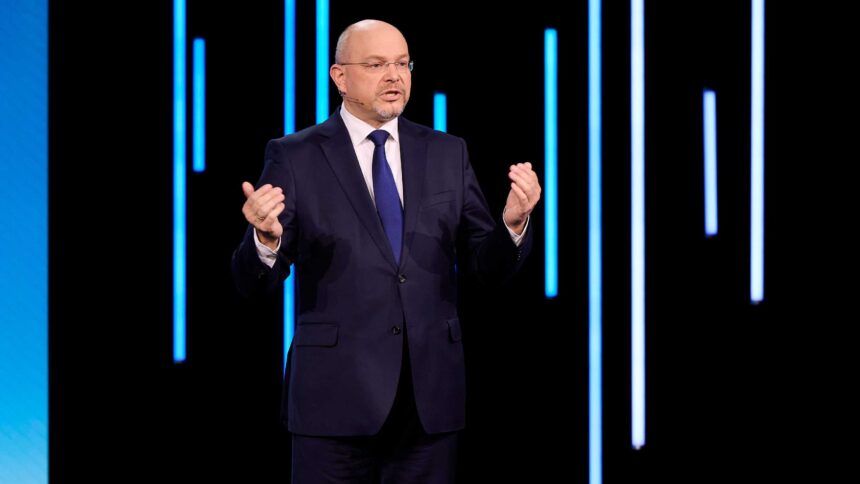
Statement
Walter Mertl
Member of the Board of Management of BMW AG, Finance
Annual Conference 2026
- Advertisement -
BMW Welt in
Munich
, 12 March 2026, 08.00 a.m.
Good morning,
Ladies and Gentlemen,
For the BMW Group, 2025 was marked by fully leveraging our operating
model to deliver solid results in the face of a challenging environment.
- Advertisement -
The year was heavily impacted by tariffs, developments on currency
markets, especially in the second half of the year, as well as the
intense market situation in China.
In the face of these headwinds:
- we executed consistently on our strategy and took advantage of our
flexible global structures. - we balanced sales across our regions and our brands.
- we reduced R&D and capex thanks to early investments in the
NEUE KLASSE; and - we drove further cost reductions across the entire company.
With this, we were able to deliver on major KPIs in our operational business:
- Advertisement -
- a stable Group-EBT margin of 7.7% – the same as 2024 – with Group
earnings of more than 10 billion euros; - volume growth to 2.46 million Group vehicles;
- the continuation of our electrification story with an increase in
BEV share to almost 18% and xEV share to over 26% of total sales; - an electrified share in Europe of over 40%;
- a CO₂ fleet emissions figure in the European Union of 90.0 grams
per kilometre – 2.9 grams below the applicable target; - an Auto EBIT margin within our guided corridor;
- over 3 billion euros Free Cash Flow;
- and solid capital returns.
As I promised at the Annual Conference one year ago, we have
addressed all aspects of cost – R&D, SG&A, manufacturing and
material costs – to secure a consistent year-over-year reduction in
every quarter. This amounted to an overall Auto EBIT tailwind of
approximately 2.5 billion euros for the year.
With our diligent management of the business, we have been able to
offset a large share of the challenges we faced. Without the full-year
tariff burden of approximately 1.5 percentage points of EBIT margin,
both our Group earnings as well as our Auto EBIT would have been above
the previous year.
Let me now take you through our financial figures in detail.
For the full year, Group revenues totalled 133 billion euros.
Earnings before Tax at Group level amounted to over 10 billion euros,
as anticipated at Q3. This represents a single-digit percentage
decline of 6.7%. The resulting Group EBT Margin remained stable at
7.7% for the year. Earnings per share even rose slightly year-on-year.
If we look at the breakdown of the Group performance by segment:
The Automotive Segment delivered 6.3 billion euros
in earnings with an EBIT margin of 5.3%.
Motorrad EBIT reached 178 million euros with a margin
of 5.7%.
Financial Services generated 2.4 billion euros in
earnings before tax and a Return on Equity of 14.3%.
All three operational segments were therefore within their respective
guidance corridors.
Other Entities improved to just over 1 billion euros
in EBT. The positive trend after nine months continued into Q4.
And finally, Eliminations amounted to an EBT of 629
million euros. This reflects the positive development in Q4, as anticipated.
Let’s look at how the Automotive Segment performed
across key metrics:
Over the course of 2025, the BMW Group sold over 2.46 million
BMW, MINI and Rolls-Royce vehicles to customers
worldwide, an increase of 0.5% over 2024.
Looking at the regions, we see our global model at play, as we steer
effectively across geographies. As Oliver Zipse highlighted before,
sales in Europe and the United States outperformed the market,
delivering an increased market share and overcompensating the
development in China.
We delivered a stable monthly run-rate for the BMW brand of around
50,000 vehicles throughout the entire year in China – despite the
intense market environment. During the course of the year, we have
taken actions to consolidate dealer structures and address pricing,
which will underpin this stability in the market.
Excluding the Chinese market, global Group sales in 2025 grew by 5.9%.
Electrified vehicles are both a foundational pillar
in our strategy, and also a key growth driver – thanks to our
expanding portfolio of attractive products.
Oliver Zipse has already taken you through the figures in detail. But
the highlights were:
- a total of 642,000 electrified vehicles delivered in 2025;
- representing solid growth of 8.2% and an overall xEV share of over 26%.
- and deliveries of all-electric vehicles of 442,000 units for a
share of almost 18%.
Revenues in the Automotive segment came in at nearly
118 billion euros, 5.9% below 2024. Approximately half of this
decrease is due to negative currency effects. The remainder results
mainly from global pricing pressure.
Let’s look at the year-on-year Automotive EBIT
result in detail, coming from our previous year’s earnings.
The net balance of currency and raw material
positions resulted in a headwind of 600 million euros.
Negative trends in FX outweighed the slight positive effects from raw
materials, particularly in the second half of the year. This adverse
FX development is expected to carry into the first half of the current
year, mainly in Q1.
Compared to 2024, the net effect of volume, model mix and
pricing weighed on Automotive EBIT by a total of 1.8 billion
euros. The overall mix effect was positive, driven notably by a strong
share from the mid-class including 5 Series growth as well as a record
M performance. For the full year, pricing was a significant headwind
of 2 billion euros.
In line with our planning, we continued to decrease operating costs
in 2025. As planned, we reduced R&D expenses
following the peak in 2024 – with a nearly 800-million-euro reduction
year-on-year. SG&A savings represented 900
million euros, continuing the trend from the first nine months.
Other Cost Changes amounted to a headwind of 800
million euros. This development resulted from a few areas:
On the one hand, tariffs had a negative impact of approximately 1.5
percentage points on the Auto EBIT margin. In addition, a softening
market on residual values weighed on earnings. They remained positive,
but lower than the previous year.
On the other hand, warranty expenses were significantly lower
year-on-year, as outlined at Q3. An additional positive effect came
from a high three-digit million saving in manufacturing and material costs.
Overall, we reduced costs by 2.5 billion euros for the full year
through our active steering of R&D, SG&A and manufacturing and
material costs. Through this, we were able to offset all headwinds
except a portion of the approximately 1.5 percentage point tariff
burden, resulting in a net year-on-year decrease of 1 percentage point
in EBIT.
In total, segment earnings in 2025 reached 6.3
billion euros.
The reported Automotive EBIT margin came in at 5.3%.
Excluding the 1.3 billion euros depreciation resulting from the PPA of
BMW Brilliance Automotive, the EBIT margin reached 6.4% for the year.
And that still includes the headwind of approximately
1.5
percentage points from tariffs.
As you know, our focus is consistently on our reported figures. Due
to different approaches in the industry, however, consideration of PPA
and Tariff burden ensures better comparability of operational performance.
Looking at R&D and Capital Expenditure in detail:
We made early investments to implement our strategy, which we see as
we look at R&D and CapEx development in 2025.
Group expenditure for research and development
according to the German Commercial Code for the year amounted to 8.3
billion euros. This is a decrease of nearly 800 million euros, or 8%
below the peak of 9.1 billion euros in 2024. This translates to an
R&D ratio of 6.2%. Given the lower revenue, the ratio only
declined slightly year-on-year.
Group capital expenditure totalled 7.2 billion euros,
a year-on-year decrease of over 1.8 billion euros from the peak of 9.1
billion in 2024 – or a 20% reduction. This resulted in a ratio of
5.4%. The capex ratio excluding right-of-use assets came in at 4.9%.
As promised, R&D and capital expenditure have already
significantly decreased from their peak in financial year 2024.
Despite the rollout of models of the NEUE KLASSE, we will maintain
this trend going forward. This means in both absolute and relative
terms, we’re heading back towards our strategic corridors, which are 4
to 5% for R&D and less than 5% for Capex – by 2027.
Moving to free cash flow:
Total segment earnings before tax amounted to 5.9
billion euros for the year.
Working Capital contributed positively with 900
million euros, mainly due to strict management of inventories.
The net effect from capital expenditure and
depreciation reduced free cash flow by 2.3 billion euros.
Changes to provisions had a negative impact of 1.3
billion euros, mainly due to the utilization of warranty provisions.
Following the 2.7-billion-euro figure communicated at Q3, free cash
flow developed positively in Q4 and reached 3.2 billion euros at
year-end. This was in line with our expectations of above 2.5 billion
euros for the year.
Our financial strength is further underscored by our
Automotive net financial assets. At year end, this
came in at over 44 billion euros.
Let’s now turn to our Financial Services segment.
As a key component of our BMW ecosystem, the segment consistently
contributes to Group profitability.
In 2025, new business developed positively throughout the year with
nearly 1.73 million new financing and leasing
contracts concluded. This represents growth of almost 2% year
on year.
The increase is due in particular to the positive business
development in Europe as well as the changed competitive environment
in China in the second half of the year. Since the end of June, the
market situation has been influenced by the significant reduction in
commissions from local Chinese banks in connection with the brokering
of financial and insurance products for end customers.
Penetration rates for lease and loan offerings
increased by 4.0 percentage points to 46.6%.
Overall, new business volume at Financial Services
reached an all-time high, growing by 2% to 65.8 billion euros, despite
negative currency effects.
Segment earnings before tax reached 2.4 billion
euros. The moderate decrease compared to 2024 is due to lower income
from the resale of end-of-lease vehicles, as well as a tax payment
related to changed assessments of operating taxes from previous years.
Residual values remain positive, but lower than the previous year.
The credit loss ratio of 0.28% was within our expectations.
Return on Equity for the full year reached 14.3% and
therefore within the guided target corridor of 13 to 16%.
Ladies and Gentlemen,
In 2025, the BMW Group achieved Group earnings before
tax of 10.24 billion euros. Thanks to a stable year-on-year
profit attributable to shareholders of BMW AG
amounting to 7.29 billion euros, the Board of Management and the
Supervisory Board will propose to the Annual General Meeting a
total dividend payment of 2.67 billion euros.
The proposed dividend represents a payout ratio of
36.6%, which is consistent year-over-year and in the upper half of our
strategic target range of 30 to 40%. This amounts to a
dividend of 4.40 euros per share of ordinary stock
and 4.42 euros per share of preferred stock.
Additionally, we completed the second share buyback
program in early 2025 before starting the third program after
the AGM in May. The total from both programs amounted to a payout of
1.25 billion euros in 2025. Our third share buyback program will run
until April 2027. We are currently running the second tranche of this
program – with a volume of 625 million euros for ordinary shares –
that will be completed by August 31, 2026, at the latest. The third
tranche is earmarked for after that.
For the financial year 2025, the total shareholder
return of close to 4 billion euros – comprising the proposed
dividend and share buyback – exceeds free cashflow in the Automotive
segment. This further underscores our commitment to capital returns.
That brings me to our outlook for the current
financial year.
What are our expectations for 2026?
In Europe and the USA, we see some
growth potential.
In China, we have responded to the market
environment by taking a number of steps to stabilise transaction
prices. Average sales figures over the past few months indicate that
sales in China could reach last year’s level.
Consequently, we forecast global deliveries of BMW,
MINI and Rolls-Royce vehicles to be at previous year’s level. Due to
model cycle effects as well as shifting regulatory and market
dynamics, we also expect the share of fully electric
vehicles to be at the same level as previous year.
Turning to Auto EBIT development: we continue to work diligently on
reducing costs and will see tailwinds from reduced investments, lower
manufacturing and material costs, declining R&D expenditure as
well as reduced SG&A in the 2026 financial year. We anticipate a
negative impact of approximately 1.25 percentage points from tariffs
on the Auto EBIT margin – compared to the 1.5 in 2025.
Given the significant investments made into NEUE KLASSE in preceding
years, we will see a material increase in depreciation and
amortization from both capex and capitalized R&D. While we will
continue to make significant reductions in R&D expenditure, the
additional depreciation and a lower R&D capitalization ratio,
which is expected in the 30% area, will result in a significant
P&L burden. Other headwinds in 2026 include FX and raw materials;
the measures taken in China to stabilize transaction prices; and,
finally, lower income from used car remarketing.
The reductions we will achieve on the cost side will not fully offset
these headwinds. We therefore expect an Auto EBIT
margin in the corridor of 4 to 6% in 2026. The corresponding
RoCE in the Automotive segment is forecast to be
between 6 and 10%.
In the Financial Services segment, we again
anticipate a Return on Equity of 13 to 16%.
Putting this all together, we expect Group Earnings before
tax to be moderately lower than the strong result in 2025.
The full 2026 outlook for all key performance
indicators is available in the BMW Group Report.
In addition, we expect a Free Cash Flow in the Automotive
Segment at year-end of over 4.5 billion euros.
Ladies and Gentlemen,
For 2026, we will continue to systematically implement our strategic
course, particularly with the launch of NEUE KLASSE product offensive
and the rollout of its technologies across the portfolio. We will
leverage flexibility in our global business model to tackle the
challenging and dynamic operating environment.
At the same time, we will manage our operational business with
continued focus on cost discipline. This will enable us to deliver
financial results in line with our guidance and generate strong
returns to shareholders.
Ladies and Gentlemen,
Let me pick back up on Oliver Zipse’s comments on
sustainability and CO₂
emission reporting, before I hand back over to him.
For the BMW Group, we view sustainability holistically and as a
competitive advantage. That is why we in our Annual Reporting disclose
our sustainability performance fully to our investors and customers.
In line with our strategy and our commitment to the Paris Climate
Agreement, the BMW Group considers the CO₂ emissions of vehicles –
both for the new and existing fleet –over their entire life cycle:
from raw material extraction and parts production to the manufacture
of vehicles and across the use phase to end of life. We address all
stages of the value chain with ambitious targets.
However, European CO₂ fleet emission regulations focus only on the
use phase and do not recognize the full reduction potential along the
entire value chain.
When it comes to reporting, emissions shown in sustainability
statements do not always correlate to the actual generation of
emissions of all vehicles on roads. For the 2025 financial year, the
BMW Group reporting includes all vehicles sold in the year across
their life cycle, including the CO₂ emissions from the supply chain
for vehicles produced in the reporting year; from BMW Group
production; from the assumed use phase of 200,000 kilometres for
vehicles delivered in the reporting year based on the consumption mix
of the reporting year; and from end-of-life disposal for vehicles
produced in the reporting year.
However, the use phase emissions reported in line with European
reporting frameworks do not consider all existing BMW Group vehicles
still in use, but rather only those vehicles sold in the reported year.
This means that the European reporting framework neglects the
reduction potential of the existing vehicle fleet. Here, there is
significant leverage to quickly contribute to CO₂ reductions through
use of eFuels and carbon neutral fuels such as HVO100. Immediate
credit should be given – starting, for example, in 2027 – for the CO₂
reductions achieved using sustainable fuels, which should not be
subject to limitations, such as caps on specific gram per kilometre values.
The European regulatory frameworks should reflect this holistic
approach towards reducing overall emissions in the here and now – in
both the new and existing vehicle fleet.
Because ultimately, every gram of CO₂ saved counts. That is what we
at the BMW Group believe and what makes a true societal impact.
I’ll now hand back over to Oliver Zipse to provide additional
strategic insights for 2026 and beyond.
Statement Walter Mertl, Member of the Board of Management of BMW AG, Finance, Annual Conference 2026
2026-03-12 07:22:00
www.press.bmwgroup.com
https://www.press.bmwgroup.com/canada/article/detail/T0456234EN?language=en
#Statement #Walter #Mertl #Member #Board #Management #BMW #Finance #Annual #Conference