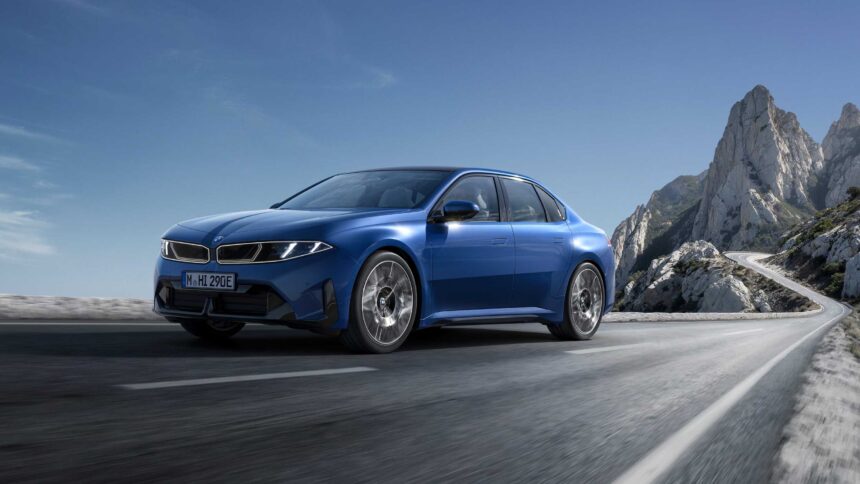
Richmond Hill, ON. The BMW 3 Series is the essence
of the BMW brand. For five decades, this icon has stood for sporty
driving pleasure, unmistakably attractive design and consistent
progress. A legacy to which every generation of the BMW 3 Series is
committed. The new, fully electric BMW i3 enhances the familiar
character of the BMW 3 Series with additional, unique features.
As the next model in the Neue Klasse, it represents a technological
quantum leap into a new era. The first battery-electric BMW 3 Series
launches as the BMW i3 50 xDrive, which has an electric motor on both
the front and rear axles. The combined system power output is 463 hp[1] while maximum torque
is 476 ft-lb. The highly efficient sixth-generation BMW eDrive
technology, together with the new BMW Panoramic iDrive and Heart of
Joy, delivers driving pleasure on a level never experienced before.
With BMW Symbiotic Drive, the assisted driving experience is also
entering a new era. The BMW i3 also stands for a modern interpretation
of the hallmark design features of a BMW Sedan.
As a representative of the new design language, the new BMW i3 is
immediately recognizable as a BMW 3 Series – assured, dynamic, and
intelligent. The hallmark BMW sporty silhouette proportions are
reflected in the new 2.5-box design. Notable features are the long
wheelbase, the greenhouse that slopes towards the rear and the short
overhangs. The four-eyed face is familiar, yet still new. The BMW
grille and twin headlights merge into an innovative light signature,
creating a powerful and expressive unit. The rear end, featuring
horizontal rear lights, further highlights precision and technological
progress. The boldly flared wheel arches emphasise the sporty, wide
stance of the new BMW i3.
- Advertisement -
Sportiness and driving pleasure are invariably embedded in the DNA of
the BMW 3 Series. The new BMW i3 maximizes the capabilities of the
all-new EV architecture, offering impressively precise, effortless,
and assured handling. The Heart of Joy high-performance computer
shapes the BMW i3 driving experience, with responses that are ten
times faster than in previous systems. Together with three other
high-performance supercomputers, the Heart of Joy forms the
centrepiece of the new software and electronics architecture.
The new BMW i3 stands out for its excellent suitability for long
journeys. Its estimated range is up to 700 kilometres (according to
preliminary BMW AG tests based on the EPA’s test procedure standards).
DC charging capacities of up to 400 kW also drastically reduce
charging times. Sixth-generation BMW eDrive technology provides the
prerequisites for this rapid progress. It comprises highly efficient
electric motors, 800-volt technology, and new high-voltage batteries
with new cylindrical cells. The cell-to-pack design enables high
energy densities at pack level and a flatter high-voltage battery. The
BMW i3 also features the bidirectional charging functions
Vehicle-to-Load, Vehicle-to-Home and, at a later stage in Canada,
Vehicle-to-Grid charging functions.
The BMW i3 will be manufactured at the BMW Group plant in Munich,
which is the home plant of BMW. The plant in Milbertshofen, in the
north of Munich, has been producing premium vehicles for more than a
hundred years. Over the last four years, the plant has seen
significant modernization: Alongside a new body shop, a cutting-edge
vehicle assembly area and logistics space has been constructed. The
new buildings are in their final stages of expansion. Production of
the new BMW i3 for the Canadian market will start at the end of 2026
and deliveries are expected in the first half of 2027.
Design. The core of the brand reinterpreted: modern, timeless,
and unmistakeable.
- Advertisement -
In line with BMW’s new design language that debuted with the iX3, the
i3 embodies a contemporary take on the distinctive design elements
synonymous with the BMW brand. At the same time, the BMW i3 combines
future-oriented dynamics with the hallmark proportions of a sporty BMW
sedan. The DNA of the BMW 3 Series, which has been successful for
decades, is immediately apparent in its modern 2.5-box design.
Precise lines and striking surfaces characterize the clear, reduced
external appearance of the BMW i3. The modern interior has a sporty
and inviting design. Advanced digitalization shapes the user
experience just as fundamentally as the hallmark BMW driver orientation.
- Advertisement -
2.5-box design with distinctive surfaces, long wheelbase and
short overhangs.
The outline of the new BMW i3 maintains the classic, sporty
proportions typical of BMW. With a modern 2.5-box design, the i3 is
unmistakably identifiable as a BMW.
The appearance is defined by the long wheelbase, the striking
surfaces, and the short overhangs. The look of the design is both
modern and dynamic. Short overhangs and powerfully shaped wheel arches
emphasize the sporty stance. A distinctive design feature is the
greenhouse, set back from the main structure. In combination with the
flared wheel arches, this creates a powerfully athletic shoulder
surface. The precise character line, positioned low on the body
surface, brings the BMW i3’s visual centre of gravity closer to the road.
Concealed window seals ensure a direct, harmonious transition between
the glass surfaces and the bodywork. When the BMW Digital Key Plus or
physical key fob are near, the flush-mounted door handles
automatically extend.
Familiar, yet new: The front of the BMW 3 Series – a symbiosis
of geometry and light.
The front end of the new BMW i3 presents the face of the Neue Klasse
in a distinctive, modern form. The iconic BMW grille and twin
headlights seamlessly integrate with the front sensors, creating a
unified visual element that exemplifies the harmony of geometry and
light. With meticulous precision, they effectively highlight the broad
design of the vehicle.
The light signature, arranged horizontally, spans nearly the whole
front. Two daytime driving lights on the left and right with
integrated turn indicator function create a new, modern look for the
hallmark BMW four-eye face. The optional BMW Iconic Exterior
Illumination further enhances the visual depth effect of the BMW
grille. Precise contour lighting emphasizes the attractive look.
Occupying its spot in the “valley” of the sculptured hood,
the redesigned BMW roundel sits above the grille. The front is
dynamically inclined towards the road in a shark-nose design, thus
emphasizing the overall sporty character.
BMW Iconic Exterior Illumination for customizable lighting
effects.
The new BMW i3 comes to life with its light animation as soon as the
driver approaches the vehicle. The Welcome Light Animation begins on
the exterior of the vehicle and continues in the interior. The Welcome
and Goodbye Animations vary depending on the equipment level. The
optional BMW Iconic Exterior Illumination offers three impressive
lighting animations. Balanced, Relaxed and Excited are available.
Customers can individualise the Welcome Light Animation of their BMW
i3 to their personal taste.
Powerful rear, horizontal light signature.
Similar to the front of the vehicle, the rear of the new BMW i3
features a contemporary and dynamic design language. The athletic
shoulders with strongly inset greenhouse are a characteristic feature
of the rear end. The prominently flared wheel arches emphasize the
width of the sedan and its broad stance on the road. Located at the
lower rear, a diffuser element emphasises the dynamic qualities of the
BMW i3.
Strongly horizontally aligned rear lights feature a new
three-dimensional light signature and extend far into the prominent
shoulders. Two light elements per side reinterpret the familiar
L-shaped BMW rear lights in a new, abstract form. At the same time,
they underscore the width and the distinctive character of the BMW i3.
The BMW roundel is again located in the “valley” between the
rear lights.
Expressive: New Le Castellet Blue metallic paint finish.
A total of eleven different exterior colours will be available at the
market launch of the new BMW i3. The new metallic colour Le Castellet
Blue is exclusive to the range. Solid, frozen, and metallic finishes
are also available.
Interior: An inviting experience space – driver-oriented,
digital, and modern.
The interior of the BMW i3 brings the design language of the Neue
Klasse to life with clear intensity. The interior design is dynamic,
airy, and modern and stands for optimal driver orientation, redesigned
user interaction, and a harmonious interplay of geometry, light, and
sound. Digital and real content merge through the coordinated design
of the ambient light and the graphics on the central display and the
BMW Panoramic Vision.
The Free-Cut Design Central Display is angled slightly towards the
driver. The lines of the instrument panel flow horizontally on both
sides into the dynamically designed door panels. This creates an
enveloping wrap-around effect for the passengers, which continues
throughout the interior. The standard Panoramic Roof with Climate
Glass, in combination with the large window areas, creates a feeling
of space flooded with light.
Driver orientation: Precise and intuitive.
The BMW Panoramic Vision and the optional BMW 3D Head-Up Display
project driving-relevant information directly into the driver’s line
of sight. This eliminates the need for cockpit displays behind the
steering wheel, which is now completely redesigned. For the first time
in a BMW 3 Series, it has a centre spoke in the upper section. In
addition to distinctive thumb rests for improved ergonomics, it has
multifunction buttons for intuitive operation. This follows the
hallmark BMW principle of “Hands on the Wheel, Eyes on the
Road”. An M Steering Wheel with a flattened, dynamic design and
spokes at the four and eight o’clock positions will also be available.
The Free-Cut Design Central Display equipped with matrix backlight
technology is also positioned right next to the steering wheel, angled
towards the driver for even more direct driver orientation.
The BMW i3 offers customers comprehensive options for personalization
in the areas of lighting, sound, displays and drives via My Modes.
Multifunction Seats.
The new BMW i3 comes with sporty and elegant seats that provide a
high level of comfort and secure lateral support. Multifunction Seats
are available as an option.
The BMW i3 features electrically operated door latches front and
rear. The centre console between the driver and passenger seats
includes a storage area with inductive charging function, the gear
selector, and physical buttons for parking brake and hazard warning lights.
Choice of numerous interior designs.
The BMW i3 features precisely coordinated interior designs with its
selection of materials and hues. The standard Veganza upholstery is
available in Agave Green, Digital White, Castanea, and Black. Black
Merino Leather from BMW Individual can also be optioned.
Sporty style with the M Sport Package.
The M Sport Package is available as an option for the new BMW i3.
Among other things, it includes the M Aerodynamics Package, Dark Blue
M Sport Brakes, a Sport Steering Wheel, and exterior mirror projection
with M logo.
Display and operating system, digital user experience. Modern
digital technology meets hallmark BMW driver orientation.
For decades, BMW vehicles have been regarded as leaders in intuitive
operation and exceptional ergonomics. This also applies to the latest
BMW Panoramic iDrive display and operating system with BMW Operating
System X in the new BMW i3. The entire system adheres to one
principle: the right information, in the right place, at the right
time. It is controlled by ergonomically optimized analog and digital
control elements. Many of the BMW i3’s innovations in the area of
display and control technology are protected by patent applications.
BMW Panoramic Vision: Focus on driver orientation.
At the heart of the display and operating system is the BMW Panoramic
Vision. This is a newly developed type of display in which information
is projected onto a specially coated area in the lower part of the
windscreen that stretches from A-pillar to A-pillar. The content shown
in this area is always visible and forms the visual basis of the
entire display and operating concept. Key driving information is
displayed on the left-hand side, clearly structured and in the
driver’s line of sight, without restricting their view of the road
ahead. The contents shown in the central and right-hand areas of the
display can be personalized and are visible to all occupants.
BMW 3D Head-Up Display: Animations enable spatial perception.
The optional BMW 3D Head-Up Display integrated above the BMW
Panoramic Vision projects selected content directly into the driver’s
line of sight for their exclusive benefit. This display enables
particularly precise spatial perception – for example in the case of
navigation instructions, or information from the driver assistance
system. The contents of the BMW 3D Head-Up Display and the BMW
Panoramic Vision are perfectly coordinated and complement each other,
for a consistent, clearly structured display experience.
Free-Cut Design Central Display.
The 17.9-inch Central Display in Free-Cut Design is integrated into
the BMW Panoramic iDrive as a further essential control element. It
features advanced matrix backlight technology with a resolution of
3,340 x 1,440 pixels, for a brilliant display that is easy to read in
all lighting conditions. The specific shape in the Free-Cut Design
allows for ergonomically optimal positioning, and thanks to advanced
menu structure with QuickSelect, it offers comfortable, simple and
intuitive operation via touch. There is a menu on the Central Display
containing widgets that can be moved to the BMW Panoramic Vision by
drag and drop. Up to six widgets can be freely arranged in this way to
enable quick access to frequently used functions. Using the
multifunction steering wheel, further contents and submenus of the
widgets can be displayed in the BMW Panoramic Vision.
New multifunction steering wheel with Shy Tech operating
elements.
The multifunction steering wheel employs the Shy Tech philosophy,
meaning buttons are only illuminated when the corresponding functions
are available. The controls for driving assistance and parking
functions are located on the left side, while controls for
infotainment functions such as telephone or media player are on the
right. These functions can be operated via a special control panel
that provides haptic feedback. This enables drivers to control key
functions safely and accurately without needing to take their eyes off
the road. The keys’ logical arrangement supports intuitive use and
contributes significantly to the overall ergonomic design of the system.
Customizability as a key feature of the system.
Contents, widgets and displays are individually configurable,
allowing them to be adapted to personal preferences. Users can select
colours, display schemes, and background images to create a
personalized digital experience. There is a wealth of options enabling
users to customise the user interface design in Personal Mode in line
with their own preferences, enabling advanced individualization of
displays, interactions and vehicle-related settings. Further My Modes
such as Sport, Efficient and Silent add to the range of personal
setups available to customers.
The BMW ID opens the door to the customizable driving experience with
BMW Panoramic iDrive. Up to seven different individuals can sign in to
the vehicle with their BMW ID, allowing them to enjoy every drive to
the fullest with their individual settings. The personalization
process begins with initial registration in the vehicle, which is done
by scanning a QR code in the Central Display using a smartphone. The
personal BMW ID is then added to the car and the user is guided
through the main steps of initial setup, which can also be started
prior to vehicle handover via the My BMW App if desired. At the same
time, the vehicle is automatically stored in the My BMW App along with
the corresponding profile. All personal vehicle settings, such as the
configuration of the BMW Panoramic Vision, media favorites, recent
destinations, seat settings with entry and exit configuration, and
much more, are now automatically available for every journey provided
the profile has been linked to a BMW Digital Key Plus or physical key.
Before setting off, a message greeting the customer by name will
automatically appear in the Central Display – along with their
personal profile picture, if desired.
The BMW Intelligent Personal Assistant.
The multimodal operating logic of BMW Panoramic iDrive combines
touch, haptic and voice-based interactions. A key role is played by
the BMW Intelligent Personal Assistant, the operating concept in the
new BMW i3. It enables the control of numerous vehicle functions,
navigation destinations and media contents using natural language,
without the need for defined voice commands. The self-learning voice
assistant can be activated in the usual way with the prompt “Hey BMW”
or by pressing a button on the steering wheel’s right-hand control
panel. Following initial setup, the BMW Intelligent Personal Assistant
is positioned in the centre of the BMW Panoramic Vision by default and
is always able to react appropriately to the specific context. If
desired, the BMW Intelligent Personal Assistant can make proactive
suggestions based on usage behavior and more. This intelligence is
further enhanced by the BMW Operating System X, which considers
significantly more contexts, such as driving situations, environmental
analysis, and interior recognition.
The AI technology used is a Large Language Model (LLM), a generative
AI that understands language and is capable of formulating its own
responses. This makes for more dialogue-oriented voice interactions;
it enables intuitive and intelligent exchanges and supports access to
external knowledge bases, cloud-based services and media contents as
well as the control of vehicle functions. Linking the BMW Intelligent
Personal Assistant to an Amazon account allows the user to search for
and stream music, access the latest news, and use a wide range of
other content with ease.
The interplay between BMW Panoramic Vision, optional BMW 3D Head-Up
Display, Central Display, and multifunction steering wheel –
controlled by BMW Operating System X – creates a consistent, clearly
structured display and operating concept. Physical and digital
operating elements combine to create a unified user experience that is
consistently designed with driver orientation and ergonomics in mind.
The BMW Digital Key Plus becomes the preferred vehicle key.
This means that smartphones and smartwatches from all leading
manufacturers (incl. Apple, Samsung, Google) can be easily set up to
work as a vehicle key. Ultra-wideband (UWB) and Bluetooth technology
are used to enable smartphone and vehicle to communicate with one
another at close range. The UWB technology allows the user’s location
to be pinpointed extremely precisely while also ensuring the highest
possible vehicle access security (certified according to the Car
Connectivity Consortium’s standard).
The BMW Digital Key Plus has further benefits to offer in addition to
highly convenient vehicle access. Customers can share the digital key
with others easily and securely using a messaging app, while defining
individual roles and rights at the same time. It also enables the use
of additional functions via the smartphone wallet, such as remote
operation of the trunk lid.
BMW Operating System X with high update and upgrade capability.
The BMW Panoramic iDrive software is based on BMW Operating System X.
It serves as an intelligent platform for the display and operating
system and is consistently designed for a software-defined vehicle
approach. The architecture is based on the Android Open-Source Project
(AOSP) and offers a high level of update and upgrade capability. As a
result, the system remains up-to-date in the long term and can be
continuously expanded with new functions and digital services. The BMW
Operating System X meticulously manages all aspects of interaction and
guarantees that information is consistently presented in a
context-sensitive manner aligned with the situation.
Superbrain high-performance computers and new architecture.
Compute faster and update more flexibly.
At the heart of the new architecture are four superbrain
high-performance computers. Each is assigned a core function in the
new BMW i3: The Heart of Joy primarily manages driving dynamics, while
separate computers are dedicated to automated driving and parking,
infotainment, and essential and comfort functions like vehicle access
and climate control. They offer up to 20 times higher computing power
compared to previous BMW models.
Electronics in four zones: More efficiency, less weight.
The four-zone electrical architecture reduces the complexity of the
cable harnesses. In addition, the new BMW i3 uses Smart eFuses instead
of classic fuses. This intelligent and flexible power protection
combined with the zonal architecture enables shorter and thinner
cables, saves weight, reduces energy consumption thanks to intelligent
power distribution and increases overall vehicle efficiency.
Over-the-air updates allow for continuous improvements.
The new BMW i3 will continue to receive new functions, optimized
performance, or AI-supported features via software updates long after
purchase. With its superbrains, zonal electronics architecture and
smart software, the new BMW i3 combines classic driving pleasure with
digital intelligence, creating a unique symbiosis between human and
machine. Future BMW models will feature an increasing number of
electronics and software architecture developed for the Neue Klasse.
Driving experience. Heart of Joy and BMW Symbiotic Drive for
a new dimension of driving pleasure and the joy of assisted driving.
The new BMW i3 brings sportiness, precise handling, and long-distance
comfort into the age of the Neue Klasse and make full use of
previously unattainable potentials of electromobility. The Heart of
Joy defines the brand-new driving experience – delivering greater
accuracy, improved assurance, and heightened agility. In combination
with the advanced suspension technology of the BMW i3, this creates a
completely new dimension of driving pleasure. Multiple driving and
parking assistance systems, which operate in synergy and securely with
the driver while maintaining the unique BMW character, provide
increased safety and convenience for everyday driving.
Heart of Joy: Ten times faster than previous systems.
As one of four superbrains, the Heart of Joy, together with the BMW
Dynamic Performance Control driving stack, forms the high-performance
control unit of the BMW i3. Control systems in vehicles have a long
tradition at BMW. It began back in 1979 with the first use of an
Anti-lock Braking System (ABS) in the BMW 7 Series.
The Heart of Joy controls drive, brakes, some steering functions, and
recuperation. It works at a new level and responds ten times faster
than previous systems. The result is exceptionally effortless and
assured handling. This allows the BMW i3 to navigate corners precisely
and with a light touch for maximum accuracy. The Heart of Joy reduces
the number of necessary control interventions. The resulting cornering
behavior is more consistent and predictable, which contributes to an
even greater feeling of safety.
Soft-Stop: The smoothest stopping process in BMW history.
The electric motors’ precise control ensures the new BMW i3
decelerates smoothly without any jerks or braking noise. Soft-Stop
ensures an unparalleled stopping process.
In everyday driving, the recuperation brake takes over almost all
braking operations in the BMW i3. The conventional brakes are only
used during very sporty driving or emergency braking.
Suspension: Sporty and comfortable. Optional Adaptive M
Suspension.
The new BMW i3 is distinguished by its hallmark high driving dynamics
paired with long-distance comfort. It takes advantage of the
architecture, which is uniformly designed for electric mobility. The
new, flat high-voltage battery enables a low centre of gravity. As
standard, the BMW i3 has a suspension with stroke-dependent shock
absorbers. In addition to the two-joint spring strut front axle, it
features a new five-link rear axle. Front and rear anti-roll bars with
highly preloaded bearings are used for even more dynamic handling.
Adaptive M Suspension will also be available on the i3.
BMW Symbiotic Drive ensures seamless interaction between the
driver and the driver assistance systems.
The optional Level 2+ driver assistance systems in the BMW i3 are
designed for seamless interaction between assistance and driver
inputs. The aim is not attaining the highest possible level of
automation in every situation, but a safe driver assistance experience
that offers maximum benefit and is always controllable. As a result,
the driver always remains involved in an interplay of human and
artificial intelligence. This allows acceleration, steering, or
braking even when driver assistance is engaged, without instantly
causing a deactivation of the assistance system. The clear operating
logic and displays in the BMW Panoramic iDrive ensure that assisted
driving behavior is intuitive and can be influenced at any time. The
symbiotic interplay of driver and vehicle can also be experienced with
active safety functions such as Lane Departure Warning. The driver’s
intent is inferred from steering inputs and the direction of vision,
so that the system assists with warning and steering intervention only
when the driver unintentionally drifts off his own lane or an
impending collision is detected.
Drive and battery. Technological quantum leap:
Sixth-generation electric drive with round cell high-voltage battery.
The sixth generation of BMW eDrive technology comprises a new drive
with a fundamentally new high-voltage battery concept and 800-volt
technology. The new development called Gen6 offers significantly
longer ranges, even faster charging, up to 400 kW DC charging capacity
and bidirectional charging functionality.
In addition to advanced, highly efficient electric motors, it
includes fundamentally new high-voltage batteries with cylindrical
cells. Compared to Gen5, the range is increased by 30 percent. The new
BMW i3 has a projected range of up to 700 kilometres (estimated range
according to preliminary BMW AG tests based on the EPA’s test
procedure standards) while charging speeds are 30 percent faster.
The new cylindrical cells used in the high-voltage battery have a
diameter of 46 millimetres and a height of 95 millimetres. They have a
20 percent increase in volumetric energy density compared to the
prismatic cells used in Gen5.
Cell-to-pack design enables high energy density at pack
level.
The cells are integrated directly into the high-voltage battery
without modular construction or structural elements. This cell-to-pack
design enables high energy densities at pack level and saves weight
and costs.
In addition, the combination of cell design and cell-to-pack
construction paves the way for the flat design of the Gen6
high-voltage battery. This is an in-house development and – starting
with the cell and ending with integration into the vehicle – the
result of BMW’s expertise in battery technology built up since 2008.
Pack-to-open-body construction allows for flat design.
Thanks to the pack-to-open body concept, the battery housing in the
new BMW i3 also functions as a structural component. The chassis has
an open floor, which is closed by installing the high-voltage battery.
The housing cover thus assumes the function of the vehicle underbody.
The omission of this usual underbody saves weight and, combined with
the high-voltage battery design, paves the way for the flat and
aerodynamically efficient design of the BMW i3. Another advantage: The
torsional rigidity of the body also benefits from the
pack-to-open-body construction, which has a positive effect on driving dynamics.
Energy Master: The highly intelligent control centre.
The electrical and electronic components for the high-voltage battery
can be found in the Energy Master positioned on top of the
high-voltage battery. The Energy Master, developed in-house by BMW,
provides electricity to the electric motors and the vehicle electrical
system. It is also the interface for all data from the high-voltage
battery. It ensures intelligent, efficient, and safe battery operation.
Two highly efficient electric motors with EESM and ASM
technology.
The BMW i3 50 xDrive has an electric motor on the front and rear
axles. Together, they provide a system output of 463 hp and 476 lb-ft
of torque.
An electrically excited synchronous motor (EESM) designed for the
800-volt architecture is integrated into the rear axle, the primary
drive axle. This EESM forms the centrepiece of the Gen6 drive
technology of the Neue Klasse. It is based on a stator, which
generates a rotating magnetic field by means of three-phase
alternating current, and a rotor, which has electrically excited
electromagnets. This design makes the EESM fundamentally different
from motors with permanent magnets, as the magnetic field in the rotor
can be flexibly regulated. This ability makes it possible to reduce
the magnetic field at low load and thus avoid losses. On the other
hand, particularly strong magnetic fields can be generated under high
load. This results in high torque and constant power output up to
maximum motor speed.
The entire system is controlled by an inverter, which converts the
direct current of the battery into the required alternating current
and at the same time ensures that the rotor is excited as well as all
control and monitoring processes. As a result, EESM is always operated
at optimum efficiency. Its technology distinctly sets it apart as a
unique selling point in the competitive landscape. Its efficiency and
performance development are among its most important advantages.
The EESM in the BMW i3 50 xDrive is supplemented by an asynchronous
motor (ASM) on the front axle. The ASM works on the induction
principle and is a compact and lightweight addition to the EESM. The
ASM differs fundamentally in its rotor design: Instead of magnets or
electrical excitation, the rotor consists of aluminium rods that are
connected via short-circuit rings. The necessary torque is generated
by induced currents that occur when there is a difference in speed –
known as slip – between the stator field and the rotor. The ASM is
particularly robust and resistant to heat and its compact, sustainable
construction uses only iron and aluminium. The combination of both
types of motors enables a technological quantum leap: Together, they
reduce energy losses by 40 percent, reduce the weight of the drive
system by 10 percent, and reduce manufacturing costs by 20 percent
compared to the already powerful previous generation.
The EESM of the new BMW i3 is manufactured at the BMW Group plant in
Steyr in Upper Austria, and the high-voltage battery at the BMW Group
plant in Debrecen in Hungary. The BMW Group’s Landshut plant is
contributing the Energy Master.
BMW Charging. Revolutionary advances in range and charging
speed combined with innovative charging solutions.
As a further innovation, the new BMW i3 will have bidirectional
charging functions. The energy stored in the battery can thus be used
not only for the drive and the electrical consumers in the vehicle,
but also for the following applications:
Vehicle-to-Load (V2L): This turns the new BMW i3 into
a mobile power bank that provides electricity directly from the
high-voltage battery. For example, to operate an electric barbecue on
a weekend trip or to charge the battery of an e-bike with up to 3.7 kW.
Vehicle-to-Home (V2H): Bidirectional charging turns
the BMW i3 into a home energy storage system: In conjunction with the
BMW Wallbox Professional, V2H allows the vehicle to function as a back
up emergency power supply in the event of an outage. The ability to
use the i3 as a storage unit for solar energy generated by home-fitted
photovoltaic systems will become available in the future.
Vehicle-to-Grid (V2G): Available at a later stage in
Canada, V2G will allow the BMW i3 to be integrated into the public
power grid and feed energy from the vehicle’s high-voltage battery
back into the system.
Simple, convenient, digital: Charging becomes an experience.
The BMW i3 features many innovations for convenient and fast charging
on the go. This includes, for example, the route optimized for
charging planned according to individual criteria with automatic
battery preparation for faster DC charging. Or the convenient charging
stop with an intelligent charging flap that opens automatically and
Plug & Charge for automatic payment authentication at select
charging stations.
Route planning optimized for charging:
The BMW Maps navigation system calculates a route optimized
for charging, including charging stops, if the destination is
outside the current range.
The driver determines the charging status at which charging stations
and the destination should preferably be reached and which charging
station providers should be preferred. By using AI, the system learns
from past charging processes, for example, the realistically expected
charging power, the susceptibility to faults or the exact location
data of individual charging stations and includes the optimal charging
station in the planning of the route. Customers receive dynamic
charging information including the number of charging stations,
charging availability and plug types. The expected duration and costs
of charging stops are shown in advance. Charging station reviews and
nearby amenities such as restaurants, playgrounds, restrooms, or
shopping facilities are also shown.
Battery preparation for faster DC charging: The
battery preparation ensures that the high-voltage battery is brought
to the optimal temperature before a charging process at a DC charging
station. This increases charging capacity immediately after plugging
in and shortens the charging time. When the driver actively routes to
a DC charging station with BMW Maps, the BMW i3 automatically
conditions (heats or cools) its battery. Alternatively, the function
can be activated manually via the Central Display or the My BMW App.
The current status of the battery temperature and the time remaining
for battery preparation can be viewed at any time in the BMW i3
vehicle status and in the My BMW App.
Intelligent charging flap: The charging port is
located on the rear right side of the new BMW i3While it’s possible to
open the charging flap manually, it is no longer necessary as it will
open automatically when the customer’s charging request is detected..
One of the triggers for opening is AI-supported: If the customer walks
towards a known or learned charging point, the movement path reveals
the charging intention, whereupon the flap opens. If no charging cable
is connected, the charging flap closes automatically – as it does
after the charging process is complete or when the vehicle is ready to drive.
NACS charge port standard: The new BMW i3 will be
fitted as standard with a NACS (North American Charging Standard)
charging port. This will provide i3 owners access to the vast
Supercharger network, while a CCS (Combined Charging System) adapter
allows access to other providers from coast to coast, thus ensuring
that i3 owners are never far from a provider no matter where their
journey takes them.
Sustainability in the product. Holistic concept for
conserving resources and reducing CO
₂
e emissions.
As with the BMW iX3, BMW is also taking a holistic approach to
sustainability with the new BMW i3. The focus is on decarbonization
along the entire life cycle – from product development, supply chain
to production and use phase.
The BMW i3 is thus making a contribution to achieving the CO₂e goals
that the company has set for 2030, 2035 and 2050.
The CO₂e advantage is already apparent after 1–2 years of use.
Depending on the drive variant, annual mileage, and source of the
electricity used for charging, the new BMW i3 50 xDrive achieves a
CO₂e benefit over a comparable model with an internal combustion
engine1 after just 1–2 years of use.
Decarbonization in the supply chain.
A key starting point for reducing CO₂e emissions is targeted
decarbonization along the supply chain. Renewable energy, increased
use of secondary materials, and product and process innovations
contribute to a significant reduction in emissions in the supply chain
of all drive variants.
The result of this consistent approach can be proven by the emissions
reductions achieved: CO₂e emissions in the supply chain were reduced
by around 33 percent even during the product development of the BMW i3.
Innovative materials and technologies in construction.
The “Design for Circularity” principle is also
systematically applied in the new BMW i3. This approach entails an
enhanced utilization of secondary materials, strategic selection of
materials, and the optimization of dismantling capabilities.
In the front bumper of the BMW i3, 30 percent recycled plastic is
used in the trim. In addition, the variety of materials in the entire
bumper without attachments has been reduced from 15 to 7 materials
compared to its predecessor (BMW 3 Series). Thanks to the extensive
use of a plastic especially suitable for recycling, the proportion of
recyclable plastics was increased from approximately 46 percent in the
predecessor model to approximately 85 percent. This creates the basis
for the recovery of high-quality recycled plastics from the vehicle.
Use of secondary materials in the new BMW i3.
The new BMW i3 consists of a total of around 30 percent of secondary
materials: The proportion of secondary materials in the aluminium cast
components of the new BMW i3 swivel bearings and hub carriers is 80
percent; the cast aluminium rims consist of 70 percent secondary
aluminium. The housing of the Gen6 motor also consists of
approximately two-thirds recycled aluminium.
The Gen6 battery cells of the BMW i3 high-voltage battery pack use a
proportion of secondary materials for cobalt, lithium and nickel.
Energy from renewable sources is also used in the production of anode
and cathode material as well as in cell production. Compared to a
previous Gen5 cell in the BMW i4, the CO₂e footprint in the cell
supply chain was reduced by around 33 percent per Wh. Another example
of the innovative use of materials and secondary materials is the
engine compartment cover and the storage compartment under the hood of
the BMW i3. The base material consists of 30 percent recycled marine
plastic. This is post-consumer material made from used fishing nets
and ropes. The starting material of the yarn for the textile of the
headliner and the A-pillar in the BMW i3 consists of 100 percent
recycled material.
In line with the sustainability goals of the BMW Group.
BMW’s commitment to the Paris Climate Agreement and to Net Zero by
2050 at the latest is an integral part of the holistic 360°
sustainability approach, which is anchored in the corporate strategy.
The company has set itself ambitious, scientifically derived CO₂e
targets for the coming years. For example, BMW intends to reduce its
CO₂e emissions by a total of at least 40 million tons of CO₂e in 2030
and by around 60 million tons of CO₂e by 2035. This means an
additional reduction of around 20 million tons of CO₂e in addition to
the existing 2030 target.
-30-
BMW Group in Canada
BMW Group Canada, based in Richmond Hill, Ontario, is a wholly owned
subsidiary of BMW AG and is responsible for the distribution of BMW
luxury performance automobiles, Sports Activity Vehicles, Motorcycles,
and MINI. BMW Group Financial Services Canada is a division of BMW
Group Canada and offers retail financing and leasing programs and
protection products on new and pre-owned BMW and MINI automobiles, as
well as retail financing for new and pre-owned BMW Motorcycles. A
total network of 51 BMW automobile retail centres, 26 BMW motorcycle
retailers, and 31 MINI retailers represents the BMW Group across the country.
For more information, please contact:
Marc Belcourt
Director, Corporate Communications
BMW Group Canada
marc.belcourt@bmwgroup.ca
Jean-Francois Taylor
Product and Technology Manager, Corporate Communications
BMW Group Canada
jean-francois.taylor@bmwgroup.ca
[1] All
specifications contained within this document including power and
range are preliminary and are subject to change.
The New BMW i3: An authentic BMW sports sedan for the Neue Klasse era.
2026-03-18 10:00:00
www.press.bmwgroup.com
https://www.press.bmwgroup.com/canada/article/detail/T0456413EN?language=en
#BMW #authentic #BMW #sports #sedan #Neue #Klasse #era