GM safety advances are helping protect families as summer driving season begins
2026-06-24
As summer driving ramps up across the country, so do the risks on the road. The stretch between Memorial Day and Labor Day is often referred to as the “100 deadliest days,” especially for teen drivers, making this an important moment to look at how General Motors’ safety culture comes to life in the vehicles families drive today.
- Advertisement -
GM has advanced vehicle safety over many decades, helping to protect the lives of customers and their families. The people behind this work include the engineers, researchers, and technical experts who are constantly working to reduce crashes, reduce injuries, and build greater confidence and peace of mind for drivers.
“At GM, product safety is not just a feature. It is a core value embedded in who we are and how we work, and it is built into every stage of vehicle development — from concept and design to deployment and real-world performance,” said Regina Carto, vice president of Global Product Safety, Systems and Certification.
A legacy of safety innovation
Caption: 1990 Chevrolet Suburban and 2026 Chevrolet Traverse Thursday, June 18, 2026 at the General Motors Proving Ground in Milford, Michigan. (Photo by John F. Martin for General Motors)
That commitment is grounded in a long history of innovation. GM was the first automaker to conduct crash barrier testing in 1934, helped create the first standardized crash test dummies in the early 1970s and began using a crash test dummy representing a fifth-percentile female in the 1980s. Decades of testing with a diverse set of dummies are associated with reduced fatalities and injuries for all occupants.
- Advertisement -
Today, this legacy can be seen in the contrast between a 1990 Chevrolet Suburban and a 2026 Chevrolet Traverse — a comparison that helps show just how far vehicle safety has come over time. But the message is not only about how far GM has progressed. It is also about how that progress is showing up in today’s GM vehicles.
Safety features protecting families
Caption: 2026 Chevrolet Traverse, 2026 Trax and 2027 Bolt Thursday, June 18, 2026 at the General Motors Proving Ground in Milford, Michigan. (Photo by John F. Martin for General Motors)
- Advertisement -
The 2026 Chevrolet Traverse is a strong example in the highly competitive three-row SUV segment, offering more than 20 standard safety and driver assistance features. For families, that includes a broad mix of core technologies and available features designed to help drivers avoid crashes and better protect occupants in everyday driving.1
The 2027 Chevrolet Bolt reinforces the same point in the EV segment. Every Bolt offers more than 20 standard safety and driver assistance features, including Adaptive Cruise Control, Front Pedestrian Braking, Lane Keep Assist with Lane Departure Warning, Side Bicyclist Alert, Intersection Automatic Emergency Braking, Blind Zone Steering Assist and Rear Cross Traffic Braking.1 It is a strong example of how meaningful technology is showing up in an affordable EV with a starting price under $30,0002.
The 2026 Chevrolet Trax helps tell that affordability story, too, with standard features including Automatic Emergency Braking, Front Pedestrian Braking, Lane Keep Assist with Lane Departure Warning, Following Distance Indicator, Forward Collision Alert1 and IntelliBeam, at a starting MSRP of $21,7002.
“We’re proud of how we’re delivering a set of confidence-building safety features as standard equipment on vehicles that are within reach for more households,” Carto said.
Real-world results matter
Caption: 2027 Chevrolet Bolt demonstrates Child Obstruction Detection, an Automatic Emergency Braking technology, Thursday, June 18, 2026 at the General Motors Proving Ground in Milford, Michigan. (Photo by John F. Martin for General Motors)
Recent findings from the University of Michigan Transportation Research Institute help reinforce why that matters. The study examined approximately 12 million GM model year 2020-2024 vehicles and matched them to more than 700,000 police-reported crashes across 18 states. The findings showed statistically significant reductions in several crash types, including backing crashes (86%), rear-end crashes with injury (57%), front pedestrian crashes with injury (35%), roadway departure crashes (15%) and lane-change crashes (13%).
“The results of this study give us real-world evidence that GM’s safety technologies are doing exactly what they’re designed to do: helping drivers avoid crashes and reducing injuries in everyday driving environments,” Carto said.
A holistic approach to safety
Caption: 2026 Chevrolet Blazer EV demonstrates Intersection Automatic Emergency Braking technology Thursday, June 18, 2026 at the General Motors Proving Ground in Milford, Michigan. (Photo by John F. Martin for General Motors)
GM’s progress reflects a holistic approach to safety — one that combines research, vehicle technology and safety advocacy to help improve safety for everyone who shares the road. Complementing the effort to help drivers avoid crashes is ongoing work to strengthen foundational crash safety performance, including designing vehicles to better protect people in real-world crashes and working to optimize the post-crash experience for occupants and first responders.
Most of all, GM’s work gives people a clearer sense of how its safety culture shows up in the products it builds. The company says that culture is reinforced in ways large and small, from beginning meetings with safety talks to celebrating Global Safety Week and encouraging employees to raise concerns through its Speak Up for Safety program. GM received about 4,700 Speak Up for Safety submissions in 2025, reflecting the role employees across the company play in supporting customer safety.
As more families prepare for summer road trips, GM’s message is straightforward: advanced safety technology1 matters, real-world results matter and customers should be able to find effective safety features in vehicles that are accessible to more households.
“At GM we are always innovating, learning and working to build greater confidence and peace of mind for our customers and their families,” said Carto.
1 Safety or driver assistance features are no substitute for the driver’s responsibility to operate the vehicle in a safe manner. The driver should remain attentive to traffic, surroundings and road conditions at all times. Visibility, weather, and road conditions may affect feature performance. Read the vehicle Owner’s Manual for more important feature limitations and information.
2 The Manufacturer’s Suggested Retail Price excludes destination freight charge, tax, title, license, dealer fees and optional equipment. Click here to see all Chevrolet vehicles’ destination freight charges. Dealer sets final price.
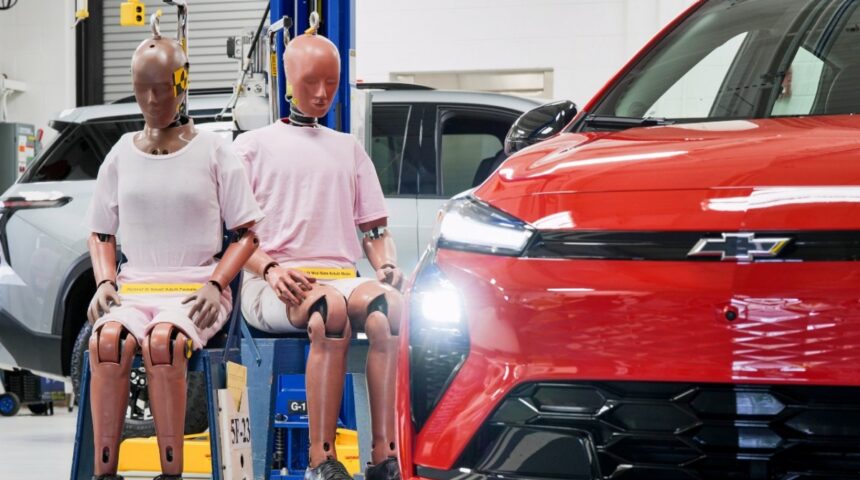
General Motors crash test dummies and the 2027 Chevrolet Bolt Thursday, June 18, 2026 at the GM Proving Ground in Milford, Michigan. (Photo by John F. Martin for General Motors)
As summer driving ramps up across the country, so do the risks on the road. The stretch between Memorial Day and Labor Day is often referred to as the “100 deadliest days,” especially for teen drivers, making this an important moment to look at how General Motors’ safety culture comes to life in the vehicles families drive today.
GM has advanced vehicle safety over many decades, helping to protect the lives of customers and their families. The people behind this work include the engineers, researchers, and technical experts who are constantly working to reduce crashes, reduce injuries, and build greater confidence and peace of mind for drivers.
“At GM, product safety is not just a feature. It is a core value embedded in who we are and how we work, and it is built into every stage of vehicle development — from concept and design to deployment and real-world performance,” said Regina Carto, vice president of Global Product Safety, Systems and Certification.
A legacy of safety innovation
1990 Chevrolet Suburban and 2026 Chevrolet Traverse Thursday, June 18, 2026 at the General Motors Proving Ground in Milford, Michigan. (Photo by John F. Martin for General Motors)
That commitment is grounded in a long history of innovation. GM was the first automaker to conduct crash barrier testing in 1934, helped create the first standardized crash test dummies in the early 1970s and began using a crash test dummy representing a fifth-percentile female in the 1980s. Decades of testing with a diverse set of dummies are associated with reduced fatalities and injuries for all occupants.
Today, this legacy can be seen in the contrast between a 1990 Chevrolet Suburban and a 2026 Chevrolet Traverse — a comparison that helps show just how far vehicle safety has come over time. But the message is not only about how far GM has progressed. It is also about how that progress is showing up in today’s GM vehicles.
Safety features protecting families
2026 Chevrolet Traverse, 2026 Trax and 2027 Bolt Thursday, June 18, 2026 at the General Motors Proving Ground in Milford, Michigan. (Photo by John F. Martin for General Motors)
The 2026 Chevrolet Traverse is a strong example in the highly competitive three-row SUV segment, offering more than 20 standard safety and driver assistance features. For families, that includes a broad mix of core technologies and available features designed to help drivers avoid crashes and better protect occupants in everyday driving.1
The 2027 Chevrolet Bolt reinforces the same point in the EV segment. Every Bolt offers more than 20 standard safety and driver assistance features, including Adaptive Cruise Control, Front Pedestrian Braking, Lane Keep Assist with Lane Departure Warning, Side Bicyclist Alert, Intersection Automatic Emergency Braking, Blind Zone Steering Assist and Rear Cross Traffic Braking.1 It is a strong example of how meaningful technology is showing up in an affordable EV with a starting price under $30,0002.
The 2026 Chevrolet Trax helps tell that affordability story, too, with standard features including Automatic Emergency Braking, Front Pedestrian Braking, Lane Keep Assist with Lane Departure Warning, Following Distance Indicator, Forward Collision Alert1 and IntelliBeam, at a starting MSRP of $21,7002.
“We’re proud of how we’re delivering a set of confidence-building safety features as standard equipment on vehicles that are within reach for more households,” Carto said.
Real-world results matter
2027 Chevrolet Bolt demonstrates Child Obstruction Detection, an Automatic Emergency Braking technology, Thursday, June 18, 2026 at the General Motors Proving Ground in Milford, Michigan. (Photo by John F. Martin for General Motors)
Recent findings from the University of Michigan Transportation Research Institute help reinforce why that matters. The study examined approximately 12 million GM model year 2020-2024 vehicles and matched them to more than 700,000 police-reported crashes across 18 states. The findings showed statistically significant reductions in several crash types, including backing crashes (86%), rear-end crashes with injury (57%), front pedestrian crashes with injury (35%), roadway departure crashes (15%) and lane-change crashes (13%).
“The results of this study give us real-world evidence that GM’s safety technologies are doing exactly what they’re designed to do: helping drivers avoid crashes and reducing injuries in everyday driving environments,” Carto said.
A holistic approach to safety
2026 Chevrolet Blazer EV demonstrates Intersection Automatic Emergency Braking technology Thursday, June 18, 2026 at the General Motors Proving Ground in Milford, Michigan. (Photo by John F. Martin for General Motors)
GM’s progress reflects a holistic approach to safety — one that combines research, vehicle technology and safety advocacy to help improve safety for everyone who shares the road. Complementing the effort to help drivers avoid crashes is ongoing work to strengthen foundational crash safety performance, including designing vehicles to better protect people in real-world crashes and working to optimize the post-crash experience for occupants and first responders.
Most of all, GM’s work gives people a clearer sense of how its safety culture shows up in the products it builds. The company says that culture is reinforced in ways large and small, from beginning meetings with safety talks to celebrating Global Safety Week and encouraging employees to raise concerns through its Speak Up for Safety program. GM received about 4,700 Speak Up for Safety submissions in 2025, reflecting the role employees across the company play in supporting customer safety.
As more families prepare for summer road trips, GM’s message is straightforward: advanced safety technology1 matters, real-world results matter and customers should be able to find effective safety features in vehicles that are accessible to more households.
“At GM we are always innovating, learning and working to build greater confidence and peace of mind for our customers and their families,” said Carto.
1Safety or driver assistance features are no substitute for the driver’s responsibility to operate the vehicle in a safe manner. The driver should remain attentive to traffic, surroundings and road conditions at all times. Visibility, weather, and road conditions may affect feature performance. Read the vehicle Owner’s Manual for more important feature limitations and information.
2The Manufacturer’s Suggested Retail Price excludes destination freight charge, tax, title, license, dealer fees and optional equipment. Click here to see all Chevrolet vehicles’ destination freight charges. Dealer sets final price.
GM safety advances are helping protect families as summer driving season begins
2026-06-24 16:30:00
media.gm.com
https://media.gm.com/content/media/us/en/gm/home.detail.html/content/Pages/news/us/en/2026/jun/0624-gm-safety-advances.html
#safety #advances #helping #protect #families #summer #driving #season #begins